
Outsourcing Custom Software Development: Pros and Cons
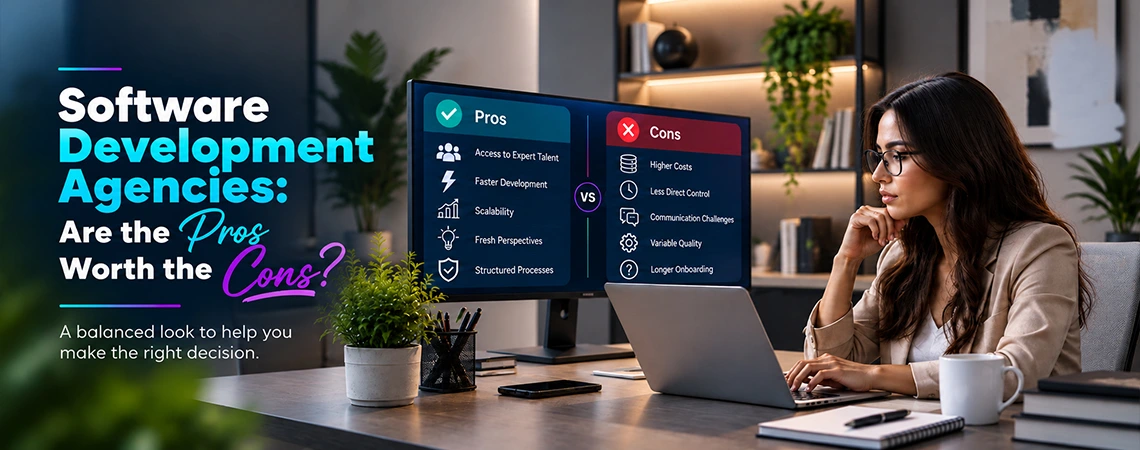
Outsourcing Custom Software Development allows for reduced hiring pressure, access to professional engineering skills, and faster product realization. It can also waste months and consume a significant budget when the selected partner lacks technical ownership, clear requirements, robust security controls, disciplined testing, or transparent reporting. The worst part is that most outsourcing problems do not happen due to the nature of outsourcing but the choice of the wrong vendor when a business selects a partner based on attractive pricing before realizing that the cost-effective solution turns out to be costly due to lack of clear requirements, poor architecture, repeated fixes, breakdowns in communication, and undocumented code. Before signing a contract, ask one question: can this partner explain how it will protect your product, budget, code quality, timeline, and business objectives at the same time?
- Outsourcing works well when you need specialized skills without having to build every role internally.
- It becomes risky when the vendor treats the project as a collection of coding tasks instead of a business product.
- A low hourly rate does not guarantee a lower project cost.
- Strong discovery, architecture, QA, documentation, security, and communication should be evaluated before development begins.
- The right partner should be able to explain what happens when requirements change, deadlines shift, defects arise, or the initial technical assumption proves wrong.
We have seen both sides during our years in software engineering. At KernDev, we have delivered 500+ projects with more than 750 IT professionals, including 500+ software developers and 45 dedicated project managers. Our work covers startups, mid-market companies, enterprises, and public-sector organizations across the United States, the UK, the GCC, and Europe. That experience has taught us something simple: outsourcing should be judged by the quality of the operating relationship, not by the number of developers placed on a project.
 What Outsourcing Custom Software Development Actually Means
Outsourcing means assigning some or all software work to a third-party development company instead of doing all the work with internal employees.
The tasks may include requirements analysis, UX design, architecture, frontend and backend engineering, database work, API development, testing, cloud deployment, security, maintenance, or several of these areas together.
The nature of the outsourcing process may differ from company to company. Thus, a startup may outsource an MVP while its internal team will take care of product management. An established retail chain may involve third-party engineers to adopt a new platform instead of maintaining an old one. A financial company may keep its responsible architects in-house and outsource some of the development and testing processes.
At KernDev, we do not consider these projects merely as a kind of staff augmentation. We begin our work with business analysis, requirements engineering, feasibility testing, architecture analysis, and delivery planning before development starts. That early work helps expose unclear requirements before they become expensive code changes.
Companies considering KernDev may also evaluate their own needs and whether they require a full-fledged engineering team or just some specialized support. The answer depends on the existing technical capability, product maturity, internal ownership, compliance requirements, and expected workload.
Outsourcing Custom Software Development Pros: Where It Can Work Well
One of the strongest reasons for relying on outsourcing is not the potential for cost savings, but rather the access to an entire array of services that a company does not have to arrange internally, including certain necessary specialists.
A custom software product may involve the work of frontend experts, backend engineers, QA experts, cloud specialists, UX designers, database professionals, security experts, project managers, and technical architects. Hiring all those professionals for a relatively short or uncertain project may create staffing challenges.
An outsourcing partner can provide these services in a single delivery model.
This is where software development services can help businesses with a product idea but insufficient internal engineering capacity to build it.
Software projects often require skills that a company may not need permanently.
A business might need a senior cloud engineer during a migration, a QA automation specialist before a major release, or an experienced architect to redesign a monolithic application. Hiring each person permanently may not fit the project's duration or budget.
The better question is not, "How many developers can you give us?"
Ask:
- Who will own the architecture?
- Who reviews the code?
- Who handles security?
- Who tests releases?
- Who manages technical debt?
- Who documents decisions?
- Who remains accountable when something fails?
A vendor that cannot answer these questions is selling capacity rather than engineering ownership.
Our IT Consulting Services team works with clients when the first problem is not coding but deciding what should actually be built. That distinction matters because writing code faster does not help when the requirements are wrong.
Outsourcing can reduce the pressure created by lengthy recruitment cycles, especially when a company needs several technical disciplines at once.
That does not mean outsourcing is automatically cheaper. Vendor management, discovery, communication, testing, documentation, and project oversight all carry costs. A quote that looks inexpensive can become costly if the team needs constant correction.
The right comparison is the total cost of achieving the intended business outcome.
For example, a company comparing an internal team with an external partner should consider:
- Recruitment and onboarding
- Salaries and benefits
- Technical leadership
- Development infrastructure
- QA and testing
- Security work
- Project management
- Training
- Employee turnover
- Post-launch maintenance
- Time lost when the product is delayed
A serious outsourcing evaluation looks at the entire delivery cycle rather than the developer's hourly rate.
An established development firm can gather a team of specialists much more quickly than a company could hire numerous professionals on its own.
This becomes increasingly important when there is a tight deadline imposed on a product, a malfunctioning system, or a need to update an old application.
Our Custom Application Services cover web and mobile application work, including application modernization, cloud applications, integrations, testing, and migration.
At the same time, having a fast turnaround means nothing if quality isn't controlled.
We have seen projects where a vendor promised a very short delivery window, only for the client to spend additional months correcting defects after launch. A faster first release is not necessarily faster delivery if the system requires a second development cycle to become usable.
Outsourcing Custom Software Development Cons: What Can Go Wrong
When outsourcing, there are risks that must be handled by the organization. Some of the major risks are poor communication, ambiguity in ownership, weak quality control, security risk, vendor dependence, lack of documentation, and misunderstanding of the requirements.
If the client does not have a technical expert who can potentially challenge vendor instructions, the risk increases.
That does not mean every business needs a full internal engineering department. It means someone on the client side must own the product decisions and understand enough technology to ask difficult questions.
Communication Problems Are Usually Process Problems
Time-zone differences receive a lot of attention, but the deeper problem is usually poor communication structure.
A team can work across several countries without major difficulty when requirements are documented, decisions are recorded, responsibilities are defined, and reviews happen consistently.
The opposite can happen with teams sitting in the same office.
We use defined project management practices, reporting dashboards, sprint reviews, technical documentation, and dedicated project managers so that a client does not have to guess what has been completed or what remains blocked.
For a company considering Design and User Experience services, this matters before development starts. A clickable interface may look finished while the underlying user journey remains unclear. UX research, wireframes, prototypes, and validation can expose those problems before engineers build the wrong experience.
The Hidden Cost of Poor Quality
Weak testing can turn a manageable outsourcing project into an expensive maintenance problem.
A development team may complete every ticket in the project management system while still producing software that fails under real usage.
That is why testing should not be postponed until the final week.
Our Quality Assurance Services covers:
- Functional testing
- Performance testing
- Security testing
- Automated testing
- UAT, web and mobile testing
- Post-launch quality control
We build QA checkpoints into the SDLC rather than treating testing as a final inspection.
For a business owner, this creates a much better question than "Did the developers finish?"
Ask, "Can real users complete the important tasks safely, reliably, and repeatedly?"
A Recent Client Experience: When Outsourcing Had to Prove Its Value
Recently, we had a client whose business was developed digitally, and he had an old application where internal functions were not efficient, and reporting was quite slow. There were also many complaints from customers about delays. The company had a business department but lacked engineering capacity to build new solutions and continue its operations at the same time.
In terms of requirements, it was important to preserve business processes in place because it was decided not only to build a new application but to take care of existing processes and functions. They wanted response times, cleaner reporting, stronger access controls, and a system that could support additional users without forcing another rebuild.
Our initial recommendation was not to start writing code.
We requested that the client allow our architects to analyze the existing application, database design, integration, user categories, reporting needs, and operational issues. During assessment, Oor engineers found duplicated business logic, inefficient database queries, tightly connected modules, and several processes that depended on manual intervention
The client thought that the development process would start in week one. However, we did not recommend this.
The first milestone concentrated on discovery and technical check-up, while the second one involved architecture and UX design. The third stage included development of the approved modules. The fourth milestone involved the implementation of structured QA and user acceptance testing. The fifth checkpoint included preparing for production release and project documentation.
The project manager spent the first two months working with the client's business stakeholders to document requirements and set up reporting protocols. The architects then divided application functionalities into components so that future changes would not require modifications throughout the entire codebase.
From the client's side, there were also security issues in terms of permissions and roles. Our engineering and security teams reviewed permissions, authentication requirements, data handling, and deployment practices before production release.
By the third month of project implementation, the project had shifted from the planning stage to the actual implementation stage. Instead of saving the finished product for the client until the end of the process, we provided parts of working software at timely intervals.
That changed the relationship.
The client was able to see what was being created, test the work assumptions, request for changes, and confirm the completed features before moving on to the next step of the process.
By the fifth month, all core modules were tested and passed the user acceptance tests. The plan for releasing included monitoring and creating documentation, as well as post-launch support.
The client did not judge us based only on the fact of launching the application, but on whether the new system contributed to minimizing the operational friction and enhancing the confidence of its internal personnel in the new technology.
This is the criterion we follow.
Outsourcing should not mean passing the responsibility to someone else and hoping for a happy ending. This is about gaining a partner who is willing to bear responsibility for his choices, report honestly about the development progress, and inform clients about possible risks in a timely manner.
When Outsourcing Is a Poor Choice
Outsourcing is not automatically appropriate for every project.
A company may be better served by internal development when the software represents its most sensitive intellectual property, requires constant product experimentation with internal teams, or depends heavily on knowledge that cannot realistically be transferred to an external group.
A hybrid model can work better in those situations.
The internal team can retain product ownership, architecture decisions, business knowledge, and critical intellectual property while an external partner handles selected development, testing, cloud, application modernization, or specialist engineering work.
Our DevOps services can fit this type of engagement when the client already owns application development but needs additional capability around infrastructure, CI/CD, containerization, monitoring, or cloud migration.
The important decision is not whether outsourcing sounds good.
It is whether the proposed delivery model gives the business enough control, technical depth, transparency, and accountability for the specific project.
What We Tell Clients Before They Sign
We tell prospective clients to ask for evidence rather than promises.
Ask the vendor to explain its development process. Ask who will actually work on the project. Ask how requirements become technical specifications. Ask how architecture decisions are reviewed. Ask how defects are handled. Ask what happens when scope changes. Ask who owns the source code and documentation. Ask how access is controlled. Ask how the vendor measures progress.
Then ask a question that often reveals more than the sales presentation:
"What happens if your team makes a technical mistake?"
A mature development partner should have a clear answer.
At KernDev, we also remove some of the initial financial pressure for prospective clients. We do not charge upfront. Clients can test our services for a month and then decide whether they want to continue working with us.
That approach gives both sides an opportunity to evaluate the working relationship through actual delivery rather than relying only on promises made before the project begins.
How to Evaluate an Outsourcing Partner Before Signing
The vendor selection stage can determine whether outsourcing saves your company time or creates another project for your internal team to repair.
A detailed sales presentation tells you very little about engineering discipline. The stronger test is to ask the company to explain how it handles uncertainty.
Ask the prospective partner:
- What happens when requirements are incomplete?
- Who makes architecture decisions?
- Who reviews code?
- How are security requirements identified?
- How frequently will working software be demonstrated?
- How are defects classified and resolved?
- What documentation will the client receive?
- Who owns the source code?
- How are third-party dependencies monitored?
- What happens after deployment?
- What happens if the assigned developer leaves?
- How does the company report project health?
The answers should form a consistent process rather than a collection of sales promises.
We recommend that clients also ask to see an example of the reporting structure they will receive. A client should be able to understand what has been completed, what is being tested, what is blocked, what decisions are required, and whether the project remains within its agreed scope.
The Difference Between a Developer and an Engineering Team
In addition to the capability to create programs, a software engineer should also be knowledgeable about testing, security, deployment, maintainability, documentation, and business parameters of the application.
The difference becomes crucial for custom products.
For example, suppose a client needs a CRM that connects sales so that the customer support service is in touch with the client via email and billing. An organization that assigns a single developer to create screens will get a product that may appear to be working but will certainly lack data architecture, access rights, integrations, testing, deployments, tracking, and maintenance.
Our CRM Development Services are designed around the client's actual workflows rather than forcing every business into the same CRM structure.
Outsourcing Custom Software Development Cons: Vendor Dependency
Vendor dependency becomes dangerous when the client cannot understand, maintain, or transfer ownership of the software.
This can happen when:
- Source code is poorly documented.
- Architecture decisions exist only in developers' conversations.
- Credentials are controlled by the vendor.
- Deployment procedures are undocumented.
- Business rules are hidden inside application code.
- Testing depends entirely on manual knowledge.
- No internal employee understands the system.
The solution is not to avoid outsourcing. The solution is to structure ownership correctly.
At KernDev, documentation and knowledge transfer form part of the delivery process. Technical and functional documentation gives the client a record of how the system works, while structured handover reduces dependence on individual team members.
A business should be able to change its relationship with a vendor without losing control of its own product.
Security Cannot Be Added at the End.
Security decisions made after development can require expensive architectural changes.
An application handling customer information, financial records, healthcare information, employee records, or government data needs security considerations from the beginning.
That includes authentication, authorization, encryption, access control, logging, dependency management, secure coding, deployment controls, and testing.
Our Cybersecurity Services work can be incorporated into software projects where security requirements need dedicated attention.
For regulated industries, the discussion must go beyond asking, "Is the application secure?"
The better questions are:
- Who can access each type of information?
- What happens after an employee leaves?
- How are privileged accounts controlled?
- What evidence exists when someone changes sensitive data?
- How are vulnerabilities identified?
- How quickly can security issues be addressed?
A vendor that answers these questions clearly demonstrates stronger engineering maturity than one that simply promises secure software.
Outsourcing Custom Software Development Pros: Access to Broader Technical Capability
The other reason companies engage in outsourcing is that the task may require various technical areas, which could be difficult to manage internally.
A platform needs mobile development, web development, cloud computing, database development, application programming interfaces (APIs), and automated testing.
For instance, our Database Development Services address areas including data architecture, query performance, data structures, and database specifications, which can be critical for a project.
Database issues are often underestimated.
The app may function perfectly with 5,000 entries and crash once the database reaches millions of records. Poor queries, absent indexes, bad relationships, too much information retrieval, and wrong storage choice can cause damage that may be much harder to fix after launch.
That's why the architecture should aim for potential future growth.
APIs Can Determine Whether a Product Can Grow
Many modern applications depend on APIs to communicate with payment systems, CRMs, inventory platforms, mobile applications, analytics systems, authentication services, and other software.
Poor API design can create dependency problems that spread throughout a product.
Our API Development Services cover API-first architecture and application connectivity where businesses need systems to exchange information reliably.
Consider an e-commerce company that has separate systems for orders, inventory, customer information, payments, and shipping. If each system maintains isolated data, employees may have to enter the same information repeatedly.
A well-planned integration can reduce duplicated work and improve data consistency.
But integration should not mean connecting everything without a plan.
Every connection introduces questions around authentication, data ownership, failure handling, versioning, monitoring, and permissions.
The Case for an MVP Before Full Development
Not every product should begin with a large development budget.
A startup may have an idea that sounds convincing but has not yet been tested with real users. Building every proposed feature before receiving meaningful feedback creates financial risk.
Our MVP Development Services approach focuses on identifying the smallest useful product that can test the core assumption.
That does not mean producing a poorly built prototype.
A useful MVP still needs appropriate architecture, security, testing, and a clear boundary around what will and will not be included.
For example, a marketplace might initially need user registration, product listings, search, payments, seller onboarding, and order management. Advanced recommendations, complex reporting, multiple payment methods, and dozens of secondary features can wait until the central business assumption receives evidence.
This is one of the areas where experienced technical judgment matters. A vendor should be willing to tell a client which features should wait.
When Outsourcing Becomes More Expensive Than Internal Development
It gets costly when the client often alters the specifications without taking into consideration its impact on time and money.
It can also get costly when the supplier begins programming before having a full understanding of the requirements.
For example, imagine a task for which the initial estimate was six months. While it is being finalized, the customer changes the payment portal, modifies the customer flow, implements a mobile application, adds some reporting requirements, changes the access levels, and requests a second market entry.
The initial estimate is no longer applicable.
A responsible supplier must clarify the implications of every change beforehand instead of silently embracing everything and not finishing a project on time.
Using a standardized process for managing changes allows for assessing their impact on technology, the schedule, interdependencies, and expenses.
That gives the client control instead of allowing scope to expand invisibly.
How We Control Risk During Development
At KernDev, our delivery process begins with business assessment and planning, followed by UX and architecture, development, testing, deployment, and post-launch support.
We use dedicated in-house teams rather than sending the project through unrelated third parties.
A typical engagement can include:
- Business and technical discovery
- Requirements documentation
- Architecture planning
- UX research and prototyping
- Iterative development
- Automated and manual testing
- User acceptance testing
- Deployment planning
- Documentation
- Knowledge transfer
- Post-launch monitoring
- Ongoing maintenance
Our IT Support Maintenance Services can continue after launch when a business needs bug resolution, updates, feature work, monitoring, or technology upgrades.
That distinction matters because software does not stop requiring engineering attention when production deployment finishes.
What a Strong Outsourcing Agreement Should Cover
A software outsourcing contract should define much more than the price and estimated delivery date.
The agreement should establish:
Scope: What exactly will be delivered?
Ownership: Who owns the source code, designs, documentation, and other project assets?
Acceptance: How will completed work be approved?
Change management: What happens when requirements change?
Security: What technical and organizational controls apply?
Data: Who can access production and development data?
Communication: How frequently will progress be reported?
Defects: How are defects classified and corrected?
Delivery: What constitutes completion?
Support: What happens after launch?
Exit: How can the client transfer the project if the relationship ends?
These clauses are not unnecessary legal decoration. They establish expectations before disagreements occur.
How We Approach Client Reporting
Business reporting should be a tool that helps the owner make decisions instead of simply confirming that developers were in meetings.
Our project managers apply structured reporting as a way to present progress, risks, pending decisions, deliverables, testing progress, and the project status as a whole.
The customer should be able to understand the content of the report without becoming a software expert.
For instance, instead of simply stating that "API refactoring is completed", a much more meaningful report might explain what business process was affected, what changes were made, what was tested, whether any dependencies are left, and what the next milestone is.
Such an approach allows deciding on success from a business perspective.
A Second Lesson From Our Client Work
A frequently occurring issue we tend to see involves a client reaching out to us following the work of some other vendor, which delivered an application that functioned correctly but was unable to provide support regarding the client's next steps.
In this case, the customer effectively paid for two cycles of development: first for the original application and then for fixing its software architecture.
Instead of immediately replacing the system, our engineers carried out the assessment of the situation first. That included the review of the codebase, database, integrations, deployment configuration, security protocols, etc.
Some of the components turned out to be useful, while others required reengineering.
This made it possible for the client to avoid costs associated with a total system rebuild since, in reality, a controlled modernization would solve the problems faced by the company.
Thus, we can see how, in our Cloud and DevOps services, assessment and migration planning can be included in the catalogue of services without imposing the necessity of discarding all old systems.
Good engineering sometimes means saying, "Keep this."
It also means being willing to say, "This part should be replaced."
The UK and US Buyer Should Ask Different Compliance Questions
US and UK companies use roughly the same technical basis for outsourcing, though the contractual and regulatory obligations imposed can vary according to several factors, including the business environment, data used, the end-user, and location.
For example, a healthcare provider in the US may have special mandates for storing and processing protected health records. A financial company may have specific requirements about protecting sensitive financial data. One UK company may have particular requirements that govern how work and data are handled.
It is incumbent upon the buyer to learn about these obligations prior to the project's commencement.
There is no point in waiting until the actual deployment to inform engineering about the emerging need for compliance with something.
What We Would Do With a $100,000 Software Budget
A firm with a financial allocation of $100,000 would like to create a personalized platform.
At the start, it wouldn't be wise to expend the entire sum.
Initially, we should clarify the commercial case, specifications, technical infrastructure, customer flows, protection policies, current technological risks, and release priorities.
A logical budget distribution strategy would imply allocating part of the financial resources to discovery work and technical infrastructure research and using the bulk of the budget for the most valuable functionalities.
The exact allocation depends on the nature of the product.
A fintech platform, healthcare application, internal ERP, marketplace, and mobile consumer application can have completely different engineering requirements.
The mistake is treating every $100,000 software project as though it represents the same amount of work.
The Final Decision: Should You Outsource?
Outsourcing makes sense when your company needs engineering capacity, specialist expertise, faster team formation, or technical capabilities that would be difficult to build internally.
It becomes a poor choice when the vendor hides its process, avoids technical accountability, gives unrealistic estimates, lacks documentation, treats QA as an afterthought, or cannot explain how it handles security and changing requirements.
When choosing a software development company, businesses should evaluate more than pricing and technical skills. Transparency, communication, project management, security practices, and long-term support are equally important for building a successful partnership.
Our position at KernDev is straightforward.
We do not expect a company to trust us because of a sales presentation.
We want the engineering process, communication, reporting, technical decisions, and actual delivery to establish that trust.
KernDev is a Texas-based software development company with 500+ delivered projects, 750+ IT professionals, 500+ software developers, 45 project managers, 340+ enterprise solutions deployed, and more than 30 years of combined software engineering experience.
We support startups, mid-market businesses, enterprises, and public-sector organizations across areas including e-commerce, fintech, HealthTech, real estate, automotive, FoodTech, EdTech, banking, HR technology, logistics, ERP, CRM, and GovTech.
We also understand that selecting a development partner is a financial decision, not merely a technical one. That is why we do not charge upfront. You can test our services for a month and then decide whether continuing with KernDev is right for your organization.
If you are comparing internal development with outsourcing, the strongest next step is not to ask which option sounds cheaper.
Ask which option gives you the technical capability, ownership, accountability, security, delivery visibility, and long-term support your product actually requires.
That is the comparison that protects your budget.
Share this Post



Blog Categories
No categories assigned to this post.