Digital Transformation Services for Businesses Outgrowing Their Current Technology
If your teams are still relying on disconnected applications, manual workflows, outdated software, or systems that are becoming harder to maintain, buying another tool may not solve the real problem.
KernDev provides digital transformation services for organizations that need to modernize how their technology supports the business. We assess existing systems, identify where technology is holding operations back, design the right architecture, and then build, integrate, migrate, test, and support the required changes.
You do not need a technology partner that simply recommends new software. You need engineers who can understand what you already have, determine what should change, and take responsibility for the technical work required to move forward.
Your Business May Not Need More Software. It May Need Better-Connected Systems
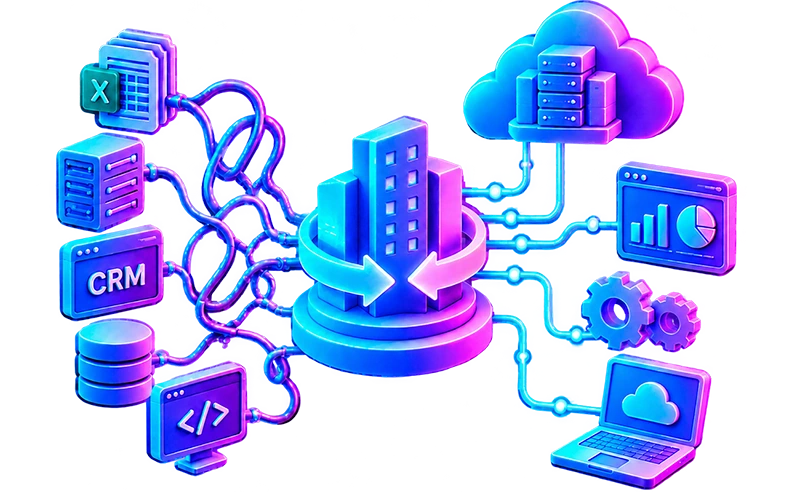
A common mistake is treating digital transformation as a software purchasing process.
A new CRM does not fix a broken customer workflow if employees still move information between spreadsheets.
Moving an application to the cloud does not solve an application architecture that is difficult to maintain.
Replacing one legacy system without considering the systems connected to it can simply move the problem somewhere else.
And automating a process without understanding why the process exists can create a faster version of the same inefficiency.
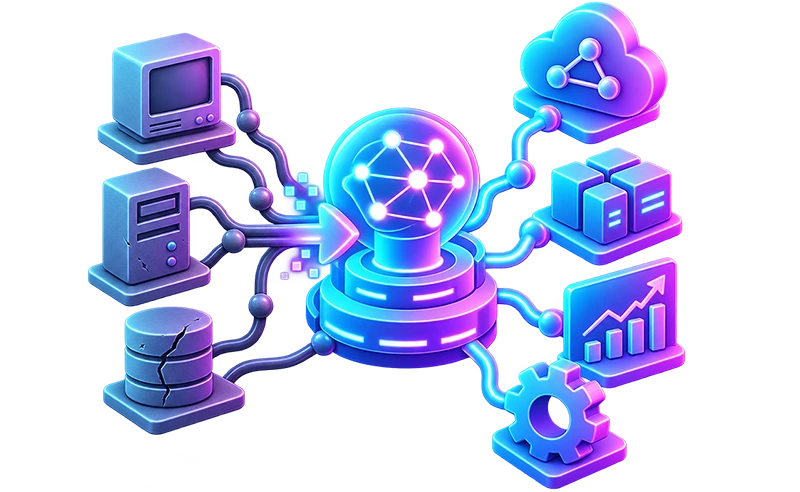
Our digital transformation service begins with the business problem rather than a predetermined technology.
We look at how your teams work, which systems they depend on, where information flows, where manual intervention is required, and which technical limitations affect delivery.
From there, Kerndev engineers can determine whether the right answer involves application modernization, cloud migration, integration, automation, data work, new software, or a combination of these areas.
The Industries We Serve

E-commerce & Freelance Marketplaces

Fintech & Financial Management

Healthcare and Wellness Solutions

Real Estate (Proptech)

Automotive and Mobility Technology

Digital Food Service Platforms

Educational Platforms

Game Design and Development

Sports and Mental Health

Banking & Finance

HRTech & Workforce Management

Logistics & Inventory
ERP (Enterprise Resource Planning)
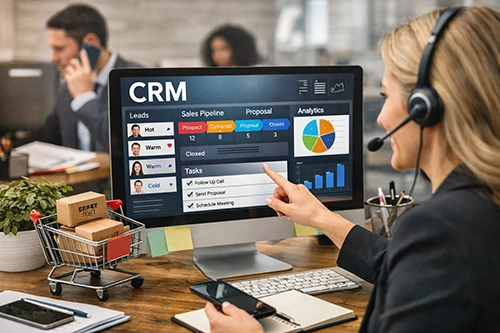
CRM (Customer Relationship Management)

GovTech & Enterprise Administration
What Digital Transformation Should Actually Change?
A transformation project should produce more than a new technology stack.
The work should make a meaningful difference to how the organization operates.
Depending on your situation, that may mean:
- Replacing a legacy application that is becoming difficult to maintain
- Connecting systems that currently operate in isolation
- Converting manual workflows into software-based processes
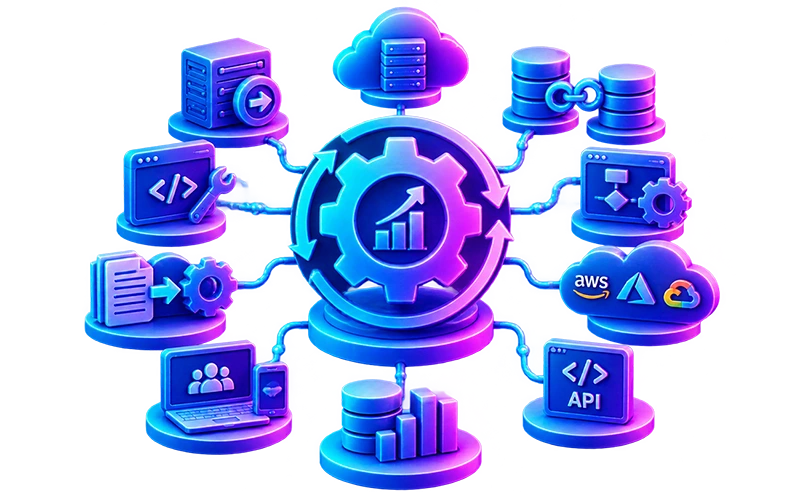
- Moving suitable workloads to AWS, Microsoft Azure, or Google Cloud
- Rebuilding parts of an application without replacing everything at once
- Creating APIs between internal and external systems
- Improving how business data moves between applications
- Introducing a new customer or employee-facing application
- Establishing a better software delivery and testing process
- Supporting an internal technology team that needs additional engineering capacity
This is where the role of a digital transformation service provider becomes important.
You should be able to understand what will actually change, why it needs to change, what will remain in place, how the work will be delivered, and who will be responsible for the technical decisions. For organizations that also need ongoing infrastructure management and deployment support, our cloud and DevOps services can help ensure that transformed applications are deployed, maintained, and scaled effectively.
That is how we structure transformation engagements at KernDev.
We Start With What You Have, Not What We Want to Sell You
Before recommending a major technology change, our engineers examine the environment you already operate in.
That can include applications, databases, APIs, cloud infrastructure, third-party platforms, integrations, security requirements, internal workflows, and development processes.
We ask practical questions:
- Which systems are creating the most operational friction?
- Which applications are difficult or expensive to maintain?
- Where are employees performing work manually?
- Which systems need to exchange information?
- Where are users experiencing unnecessary delays?
- Which legacy components are genuinely holding the business back?
- What should be replaced, and what can remain?
- What risks could a migration or application change introduce?
- Does the business need a complete rebuild or a phased approach?
This assessment prevents technology decisions from being made in isolation.
Our digital transformation services provider model combines business assessment with engineering execution, so the recommendations can be connected to the actual development work rather than ending with a strategy document. Where artificial intelligence can improve existing workflows or applications, our AI development services can be incorporated into the broader transformation approach to deliver solutions aligned with specific business requirements.
Where KernDev Can Take Responsibility
Digital transformation often crosses several areas of technology.
That is why we do not treat it as a single development task.
Depending on the engagement, our team can contribute across:
Application Modernization
We assess existing applications and determine whether they should be maintained, restructured, re-platformed, or replaced in stages.
A legacy system does not automatically need to be discarded. Sometimes the better decision is to isolate older components, introduce APIs, replace specific modules, and gradually move the application toward a more maintainable architecture.
Cloud Migration and Cloud Engineering
Cloud adoption can provide a practical path for organizations dealing with aging infrastructure or changing workload requirements, but moving applications without assessing dependencies can introduce new problems.
Our team works with AWS, Microsoft Azure, and Google Cloud and can assess application architecture, infrastructure requirements, deployment processes, security considerations, and migration dependencies before implementation.
System Integration
Businesses often accumulate separate platforms for sales, finance, operations, customer management, inventory, reporting, and internal administration.
Our engineers can design API-based connections and integration layers that allow these systems to exchange information without requiring employees to repeatedly move data manually.
Process Automation
If employees spend significant time copying information, requesting approvals through email, reconciling records, or manually moving work from one system to another, software may be able to handle part of that process.
We first understand the workflow, its business rules, exceptions, and approval requirements before deciding what to automate.
New Digital Applications
Sometimes the existing technology cannot reasonably support the required business process.
In that situation, building a new application may be more appropriate than continually modifying the old one.
Our digital transformation solutions can include customer portals, internal applications, marketplaces, workflow platforms, enterprise systems, mobile applications, and other software products where custom development is justified.
Digital Transformation IT Services Should Include Engineering, Not Just Advice
A transformation roadmap has limited value if the organization still has to find another team to execute it.
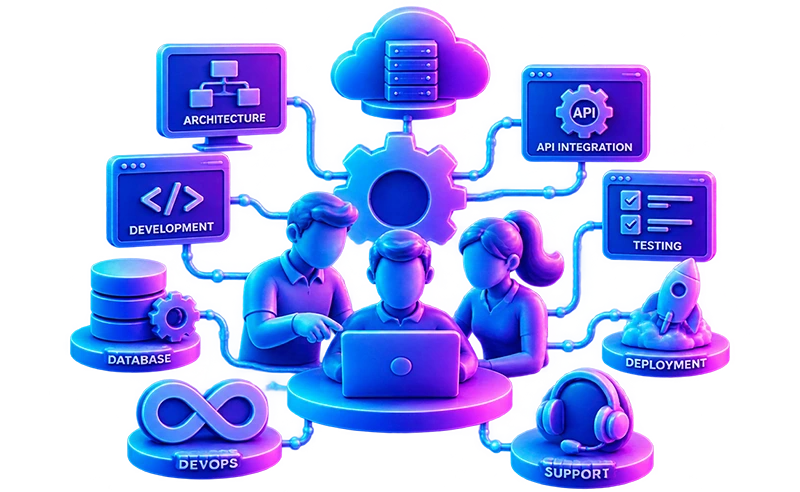
Our digital transformation IT services can cover the technical work that follows assessment and planning, including architecture, software development, API development, database work, cloud infrastructure, DevOps, testing, deployment, and post-launch support.
We can also work alongside an existing technology department.
For example, your internal team may understand the business systems better than anyone else but lack the capacity to rebuild a legacy module, establish a new integration layer, migrate an application, or support a major development initiative.
In that situation, KernDev can operate as an engineering extension of your team while your internal people retain the business and product knowledge they already have.
The goal is to add the technical capacity the project requires without forcing you to replace the team that already understands your organization. For organizations that need additional technical capacity, our software development services can support everything from individual development requirements to larger transformation initiatives.
What We Build Depends on the Problem
We do not believe every organization needs the same transformation program.
A manufacturing business dealing with legacy operational software may have very different requirements from a financial services organization connecting customer applications and internal systems.
An e-commerce business may need better integration between commerce, inventory, CRM, and reporting platforms.
A public-sector organization may have stricter requirements around security, compliance, accessibility, procurement, and continuity.
Our team considers those differences before defining the technical work.
KernDev has worked across industries including fintech, banking, finance, e-commerce, logistics, healthcare, real estate, automotive, education, HR technology, inventory management, ERP, CRM, GovTech, enterprise administration, and SLED/public-sector environments.
That breadth matters because technology decisions are rarely independent of the business processes they support.
Our Process
Business Assessment and Planning
We begin by understanding the business objective behind the technology request.
Our engineers and project managers review the existing environment, current pain points, business workflows, technical dependencies, and desired changes.
If the requirement is unclear, we do not pretend it is ready for development.
We identify the information still needed before architecture and development decisions can be made.
System and Architecture Assessment
Next, we examine how the existing technology works.
This can include application architecture, databases, APIs, integrations, infrastructure, security requirements, deployment practices, and dependencies between systems.
The purpose is to understand what can be safely changed and where the technical risks lie.
Transformation Roadmap
We then define the work in practical stages.
Some organizations may need a focused modernization project.
Others may need several connected initiatives covering applications, cloud infrastructure, integration, automation, and data.
We prioritize the work according to business requirements, technical dependencies, available resources, and the level of disruption the organization can reasonably accept.
Design and Engineering
Once the scope is established, our engineers begin implementation.
Depending on the project, that can involve application development, API architecture, cloud engineering, database development, UX/UI work, integration, automation, DevOps, or modernization of existing software.
Where the project requires a dedicated focus on the user experience, our design and UI services help shape clear, intuitive interfaces that align with the application’s functionality and business goals.
Testing and Deployment
Development is followed by testing against the agreed requirements.
Our QA team evaluates application behavior, workflows, integrations, and relevant technical conditions before deployment. The objective is to identify problems before they reach users and to give your team visibility into what has been tested and what remains to be addressed.
Support After Release
Transformation does not stop when software reaches production.
Users identify new requirements. Existing systems change. Integrations need attention. Cloud environments evolve. Business processes are refined.
Our team can remain involved after deployment so the technology continues to receive engineering and maintenance support as the organization develops.
What other Services Does Kerndev Provide?






Client Testimonials
Chief Operating Officer, Healthcare & Medical
They helped us turn a complex technology roadmap into a clear, actionable transformation plan. The team understood our challenges and delivered solutions that fit our business.
Managing Director, Retail & E-commerce
What stood out was their ability to understand both our technology needs and our customers. They helped us modernize our processes without disrupting the business.
Head of Technology, Manufacturing
Their strategic approach gave us the confidence to invest in the right technologies. We moved from fragmented systems to a more scalable digital foundation.
B2
B2
B2
B2
B2
B2
B3
B3
B3
B3
B3
B4
B4
B4
B4
B4
B5
B5
B5
B5
B5
Perks of Availing Digital Transformation Services from KernDev
You Get More Than a Development Team
What Happens When Existing Technology Cannot Keep Up
When Should You Bring in a Digital Transformation Partner?
We Do Not Assume Everything Needs to Be Rebuilt
Digital Transformation Services and Solutions Need to Fit the Business
Business Digital Transformation Services Should Address People and Process Too
Applications, Data, APIs, and Cloud Infrastructure Have to Work Together
Your Existing Team Can Stay Involved
Quality Cannot Be Added at the End
Digital Transformation Provider or Development Team? You May Need Both
The Technology Path Depends on Where You Are Starting
An Illustrative Transformation Scenario
What Happens After the New System Goes Live?
Why Organizations Work With KernDev
What Affects the Cost of Digital Transformation?
KernDev is a Texas-headquartered custom software development company with 750+ IT professionals, including 500+ software developers and 45 dedicated project managers.
We have delivered 500+ projects and developed 340+ enterprise solutions across multiple industries.
In a transformation engagement, those numbers matter because the work rarely belongs to a single technical discipline.
You may need architecture decisions from one engineer, application development from another group, QA support before release, project management for delivery coordination, and cloud or security expertise at specific stages.
Our broader engineering organization allows those capabilities to work within the same delivery environment.
We also maintain technology partnerships with AWS, Microsoft Azure, and Google Cloud, alongside PCI-DSS compliance expertise, ISO/IEC 27001 certified practices, and ISO 9001 certified quality management.
The purpose is not to put certifications on a page. It is to give your team a clearer basis for evaluating the people, processes, and technical environment behind the engagement.
If your existing technology is becoming a constraint, discuss the current environment with our engineering team before committing to a major technology change.
Digital transformation services become necessary when technology starts creating work instead of removing it.
A business may have a CRM that does not communicate with its order system, a legacy application that requires manual intervention, spreadsheets carrying information that should live in a database, or cloud infrastructure that has grown without a clear architecture. Each issue can appear manageable on its own. Together, they can create duplicated work, inconsistent information, delayed decisions, and growing maintenance demands.
Our team looks beyond the visible symptom. We examine how applications communicate, where data moves, which processes depend on people, and which technical decisions are creating unnecessary friction.
That gives us a practical starting point instead of assuming that every existing system needs to be replaced. For organizations that need to extend their digital capabilities, our mobile development services can help build applications that integrate with existing systems and workflows.
You may need external engineering support when your internal team knows something needs to change but lacks sufficient capacity, specialized expertise, or delivery resources to handle the work.
Common situations include:
- A legacy application is becoming difficult or expensive to maintain.
- Several systems hold overlapping or inconsistent business data.
- Manual processes are slowing employees down.
- Existing applications cannot support new business requirements.
- Cloud adoption has created infrastructure or operational complexity.
- Internal developers are spending too much time maintaining old systems.
- Security and compliance requirements have changed.
- New customer or employee experiences require capabilities that existing software cannot provide.
- Business leaders need a practical roadmap before committing to a large technology project.
Our role is not to replace your internal technology team. We can work alongside it, take ownership of specific engineering responsibilities, or manage the technical delivery required for a larger program. Businesses with data-driven requirements can use our machine learning development services to develop intelligent solutions that enhance existing applications, automate processes, and support more informed decisions.
A common mistake in transformation projects is treating replacement as the default answer.
An existing application may still contain valuable business rules, integrations, historical data, and workflows that the organization depends on. Replacing everything at once can introduce unnecessary risk.
Our engineers first determine what should remain, what should be changed, what should be integrated, and what should eventually be retired.
That assessment can lead to several different paths:
- Keep a stable component and connect it to newer systems.
- Refactor selected application components.
- Replace one high-risk or high-value module.
- Move suitable workloads to cloud infrastructure.
- Introduce APIs around existing applications.
- Create a new application while the existing system remains operational.
- Migrate data in controlled stages.
- Retire systems only after their responsibilities have been transferred.
This is where IT Consulting Services can support the engineering work. Business decisions need technical context, and technical decisions need to reflect how the organization actually operates.
Technology changes are useful only when they address a real operational requirement.
Our digital transformation services and solutions can cover applications, integrations, databases, cloud environments, automation, customer-facing software, internal systems, and the engineering work that connects them.
For example, an organization may need a new customer portal, but the portal itself is only one part of the requirement. Customer records may need to come from an existing CRM.
Orders may need to connect with an ERP. Authentication may need to work across several applications. Reporting may depend on information stored in multiple databases.
Our engineers consider those relationships before development begins.
Organizations that need to build or enhance browser-based platforms can also use our web development services to create scalable applications that integrate with their existing technology environment.
That is why we treat transformation as a technology program rather than a collection of unrelated development projects.
Software rarely operates in isolation.
A technically sound application can still create problems if employees have to duplicate information, follow unclear workflows, switch between too many systems, or depend on manual approvals.
Our business digital transformation services consider the relationship between the technology and the work people need to perform.
Depending on the project, that can involve:
- Mapping existing business processes.
- Identifying unnecessary manual steps.
- Defining new application workflows.
- Designing interfaces around real user tasks.
- Connecting systems that currently operate separately.
- Establishing data ownership and movement.
- Introducing automation where it has a clear operational purpose.
- Preparing users and internal teams for the changed system.
- Documenting technical and operational responsibilities.
Our custom application services can then be used when existing products cannot properly support the required workflow.
A transformation program often crosses several engineering disciplines.
A new application may depend on API development. API changes may affect database structures. Database changes may affect reporting. Cloud migration may change deployment and monitoring requirements. A redesigned user experience may require changes throughout the application stack.
Our team can bring these areas together rather than treating them as isolated assignments.
Relevant capabilities include:
Application engineering: We develop web and mobile applications around defined business requirements and technical constraints.
API engineering: We use APIs to connect applications and services where integration is required. Our API development services support systems that need controlled communication between applications.
Database engineering: We assess database structures, migration requirements, storage needs, and application dependencies. Our database development services cover work where existing data architecture needs to support changes in applications.
Cloud and DevOps: We work with AWS, Microsoft Azure, and Google Cloud environments and use practices such as CI/CD, Docker, Kubernetes, and Infrastructure as Code where appropriate. Our Cloud and DevOps services can support cloud migration and application delivery requirements.
User experience: Technology changes often require new interfaces and workflows. Our Design and User Experience services connect product requirements with the actual tasks users need to complete.
Bringing in an external engineering partner does not mean putting your internal team on the sidelines.
Your team often understands the business rules, customers, operational constraints, and historical decisions better than anyone outside the organization. Our engineers bring additional technical capacity and experience to that knowledge.
Depending on the engagement, we can:
- Work directly with your internal developers.
- Take responsibility for a defined application or technical area.
- Provide project management alongside engineering.
- Review architecture and existing code.
- Support migration planning.
- Help define technical requirements.
- Handle testing and release activities.
- Document systems and knowledge required for ongoing ownership.
Our IT Consulting Services can also be relevant when your organization needs technical assessment or planning before committing to development.
The objective is to establish clear responsibility, communication, and technical ownership rather than create another layer between business stakeholders and engineers.
Transformation projects can affect several systems at once. A defect in one integration can affect another application, a migration can affect historical information, and a change to authentication can affect multiple user groups.
Testing therefore needs to be part of the engineering process.
Our quality assurance services can cover functional testing, regression testing, integration testing, and other testing activities appropriate to the application.
We also use development and testing practices suited to the technical environment, including automated testing and CI/CD where appropriate.
Our project managers coordinate delivery activities while engineering teams address technical requirements. This creates defined checkpoints before software reaches production.
The goal is not simply to confirm that an application opens and responds. The team needs to verify that the important workflows, integrations, data handling, and expected user actions work as intended.
Security and Compliance Need to Be Considered Before Release
Changes to applications and infrastructure can also affect the organization's security exposure.
Security requirements should be considered during architecture, development, integration, deployment, and ongoing maintenance rather than treated as a final inspection.
KernDev has PCI-DSS compliance expertise and follows ISO/IEC 27001-certified practices and ISO 9001-certified quality management.
Where a project requires dedicated security engineering, our cybersecurity services can address security requirements alongside the wider development effort.
For organizations handling sensitive financial, customer, employee, or operational information, the relevant security controls depend on the application, infrastructure, data, integrations, access model, and applicable requirements.
We define those requirements in relation to the actual system instead of making broad security claims that cannot be supported by the project scope.
Choosing a partner for transformation work often means deciding how much responsibility should rest with a single provider.
A development team may be able to build a new application. A consulting firm may produce an assessment or roadmap. A cloud specialist may handle infrastructure. A security provider may address a specific risk.
The difficulty can arise when these responsibilities are split across multiple teams with limited technical coordination.
KernDev can bring consulting, architecture, design, software engineering, cloud and DevOps, QA, project management, and post-release support into the same delivery structure.
That allows the organization to discuss the business requirement with a team that can also address the engineering implications. When transformation initiatives involve complex data requirements, our data engineering services can help build the pipelines, integrations, and infrastructure needed to make business data reliable and accessible.
There is no single sequence that fits every organization.
A startup preparing its first production platform may need MVP development services to establish a focused first release before investing in a larger product.
An established organization may instead need application modernization, integration, cloud migration, or replacement of a particular legacy component.
A company with fragmented customer information may need CRM Development Services or integration work rather than a complete replacement of every business application.
A public-sector organization may have procurement, security, accessibility, data, and operational requirements that change the delivery approach. Our SLED Public Sector Engineering & Delivery Partner capability addresses engineering and delivery needs within that context.
The starting point should be the organization's actual technical and business situation.
Consider an established organization with an older internal application, separate spreadsheets used by different departments, a CRM that does not fully connect with operational systems, and several manual approval processes.
The first step would not be replacing every system.
We would map the current applications, data sources, integrations, workflows, and technical dependencies. We would identify which components are creating the greatest operational problems and determine where integration, application changes, migration, or replacement makes sense.
A phased roadmap could then introduce APIs, improve selected application components, establish a clearer data structure, connect the CRM with relevant systems, and replace manual steps where automation has a clear business purpose.
The example is illustrative rather than a claim about a specific KernDev client. The point is that transformation work should follow an assessed technical need rather than begin with a predetermined technology purchase.
Release is not the end of the engineering responsibility.
Users may identify workflow issues after real-world adoption. Integrations may require adjustments. Business requirements can change. Applications need maintenance as dependencies, infrastructure, and operating conditions change.
Our IT support maintenance services can provide continued technical support after release.
Depending on the engagement, post-launch work may include:
- Application maintenance.
- Bug investigation and resolution.
- Infrastructure support.
- Monitoring and technical maintenance.
- New feature development.
- Integration changes.
- Database support.
- Technical documentation.
- Assistance with future system changes.
This gives your organization a defined path after implementation, rather than leaving the internal team to manage every technical issue on its own.
KernDev is structured to provide engineering capacity across the stages of a technology program.
Our team includes:
- 750+ IT professionals.
- 500+ software developers.
- 45 project managers.
- 500+ projects delivered on time and on budget.
- 340+ enterprise solutions.
- 30+ years of combined software engineering experience.
- Offices across the GCC and Europe.
- Partnerships with AWS, Microsoft Azure, and Google Cloud.
- PCI-DSS compliance expertise.
- ISO/IEC 27001 certified practices.
- ISO 9001 certified quality management.
More importantly, we connect these capabilities around the project rather than treating every requirement as a separate vendor relationship.
If your organization needs a technology partner that can assess existing systems, plan the technical work, build the required software, manage integrations, test releases, and remain involved after deployment, KernDev can provide that engineering structure.
There is no single responsible price for a transformation program before the technical scope is understood.
Cost can be affected by:
- Number and condition of existing applications.
- Legacy code and technical debt.
- Number of integrations.
- Data migration requirements.
- Cloud infrastructure requirements.
- Application size and complexity.
- Number of user groups.
- Security and compliance requirements.
- UX and application design needs.
- Testing requirements.
- Required project management.
- Post-launch support.
- Whether systems are replaced, integrated, or incrementally changed.
A proper assessment can separate immediate requirements from later work.
That matters because organizations do not always need to fund every possible technology change at once. A clearly defined first phase can establish what needs to happen next and what can remain unchanged.